Website designed with the B12 website builder. Create your own website today.
Start for free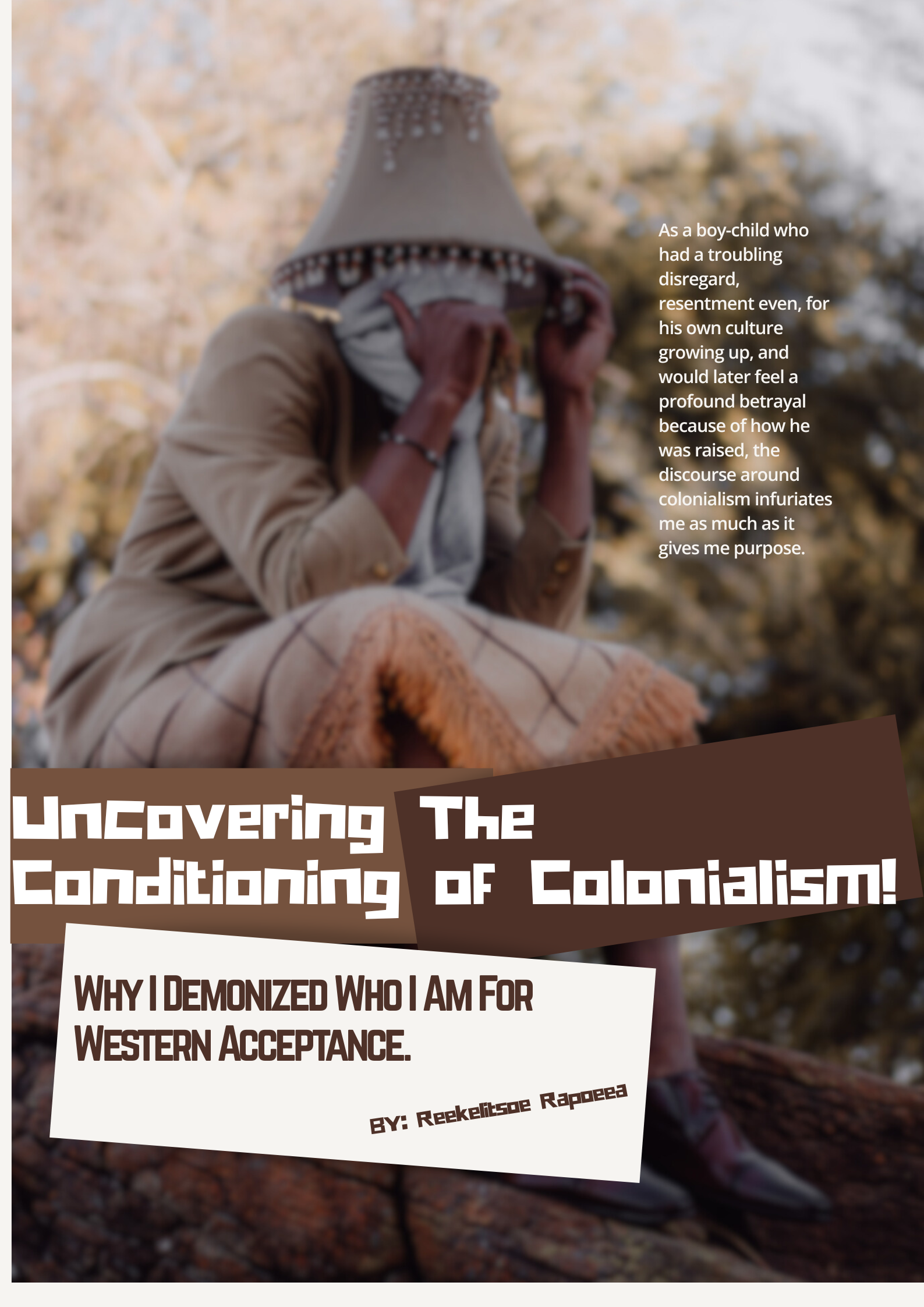
As a boy-child who had a troubling disregard, resentment even, for his own culture growing up, and would later feel a profound betrayal because of how he was raised, the discourse around colonialism infuriates me as much as it gives me purpose.
Growing up, I was left to my own devices, receiving a little guidance here and there, especially regarding important life decisions faced; it is within that context that I believe my guardians did an astounding job in shaping me into the man I am today. However, I am beseeched and somehow compelled, by my newly found Pan-African disposition and unfolding patronage, to act upon my disappointment in how I was not given even a semblance of an idea about my own culture, in how Basotho society at large seems to have given up and disregarded Bosotho in its essence, almost entirely. This lashing out isn’t directed to my guardians or any parental figure who played a role in my life, it is my belief that they were working with the cards they were dealt, and so questioning their intentions would be to spit in their faces; It is however, a seething composure towards a society that’s watching a people die by resigning to passive and half-hearted acknowledgments that it used to have a living and breathing identity and culture.
Evidently, it isn’t without cause that our society is in the straitened and adverse position it is in today. So, despite my tantrum, I recognize that there are much bigger powers at play that put my misguided fury into place, although they don’t make it any less valid. The discourse around colonialism infuriates me as much as it gives me purpose, because undoubtedly, it is the focal point and sole reason why everything went to shit for the Africans, if you will excuse my phrasing. Although its difficult to map out how life would’ve been otherwise, assuming it would’ve evolved in a way that honors our identity and values isn’t an implausible idea; So, when colonial defenders, although they would never admit to it, say that it also brought immense benefits to Africans, and that no one would ever want to go back to skinning cows and herding sheep, I sigh deeply, defeated, because that’s not what I’m asking for, although those are wonderful ideas — what I yearn for is to rediscover our values as Africans, and our identities, in order to incorporate them into our daily lives without regressing to a primitive and an uncivilized society by today’s standards, so to speak.
So, my fury has dissipated into empathy, and my empathy into action. It is when I realize that it is only through education and radical action that we can decolonize our societies that I should play my part, just like my guardians did, until we are who we should be. In one of his specials, Trevor Noah, a renowned comedian born and bred in South Africa, says that people who can confront their ugly histories are the only ones who can move forward and heal, more so, avoid repeating their mistakes. And so I implore everyone to learn their histories.
In this paper, I explore the African human Value Crisis and how Africans may go about rediscovering their values, values that were erased with methodical and cold-blooded calculation by colonization and Western textualization. It is almost admirable how they took away an African from his past, propelled them into a universe fashioned from outside, and suppressed their values, leaving them dumbfounded by a cultural inversion that marginalized them.
Below is an extract of an assignment I submitted a month ago; Although I had had multiple encounters with phenomena and literature that left me contemplating and contextualizing our history as africans, this assignment is the one that made me feel like I was done doing nothing, a final nail in the coffin, a coffin that buries the old me… an old me that is hopelessly punching the coffin with bleeding knuckles and is struggling for oxygen as he filters dust and the stench of their rotting body with all his orifices. And the current me, my heart beats with numbness, with stress, and torn heart strings because it's hard to let go, but my mind has never been clearer. So I extract this assignment for any reader who is interested, I shall recite it like a Public Service Announcement, as I mount my ass and a couple of boulders atop my own grave.
Research shows that Africans have had social, moral, and political human values way before westernization and modern education, values that were unjustly erased and replaced by colonialism. (Benson, 2011) “It is doubtless that colonialism stimulated positive and negative changes in Africa…colonial rule was an imposition that unleashed a deadly blow on African culture with the immediate consequence of the introduction of such values as rugged individualism, corruption, capitalism, and oppression.” Although not completely forgotten, a significant portion of them necessary to make Africans whole once more need to be reclaimed. I’ll be touching on the following key strategies that can aid Africans on this endeavour: Sustainable development goals (SDGs), reclaiming of indigenous artifacts, pan-africanism, and the inclusion of Tradition in Art and Popular Culture.
For a long time, Africans have had a deep-rooted, mutually beneficial, intimate, and harmonious relationship with nature. This was seen as a core human value that transcended the borders of mere human importance to some form of cosmic spirituality and interconnectedness with nature. Hadiyanto H. et al. (2021) argue that humans and their dependence on nature will never stop, and that Africans have long since revered nature and worked towards conserving it because of that fact, among other reasons. In their literary criticism of Chinua Achebe’s Things Fall Apart, they highlight that African traditional tribes learned and welcomed various seasons with respect to their differing characteristics in order to live happily with nature. This harmonious relationship was their livelihood, a livelihood which was turned upside down by colonialism in the 14th to 19th century, primarily with the introduction of the monetary system, slavery, and exploitation of resources which were extracted to European countries, with little regard to conserving the environment. Consequently, this unequivocally disturbed the African’s harmonious relationship with nature and the sacredness of life and human dignity. Sustainability Directory (2024) asserts that colonialism left in its wake catastrophic amounts of environmental debt in many regions of Africa by the cutting of trees, mining, and contaminating water, among other causes of pollution.
In order to rediscover this harmony with nature and the sacredness of life and human dignity, Africans should put into practice the Sustainable Development Goals (SDGs). I am fortunate enough to have a friend who is knee deep in the mud with his efforts to implement SDGs, and perhaps even more fortunate to have him explain to me in detail what exactly he does; it made me realize that, despite my own reservations, SDGs are a step in the right direction for Africans. The UNDP (2015) defines SDGs as global goals that aim to end poverty, protect the planet, and ensure that by 2030 all people enjoy peace and prosperity. Among these 17 goals, 4 stand out for Africans in their pursuit to rediscover the human values in question: Responsible consumption and production, climate action, life on land, and below water. Ashukem (2020) explains that the bio-economy, the act of using renewable biological resources, plays a key role in the success of SDGs. This says that using fish, crops, animals, and microorganisms to produce more food, materials, and energy lessens carbon emissions by replacing fossil-based resources. This is done in tandem with an accelerated system that immediately replenishes these renewable resources, ensuring sustainability. Without a shadow of a doubt, this is indicative of pre-colonial African values and is quite literally an adopted and modernized relationship with nature.
Another core and indispensable value and philosophy in Africa is Ubuntu. Marumo & Chakale (2018) expound that Ubuntu is characterized by the Sesotho phrase, Motho ke motho ka batho. and the Nguni phrase, muntungumuntungabantu; this is to say that each member of the community has an effect on others and others on them, creating an interdependence and interconnectedness that crosses the barrier of the living and the dead, too. This value promotes ethical and compassionate living by respecting nature, spirituality in daily life, and fostering the idea “I am because we are.” Because of this idea, Africans would often barter services and help each other, such as helping a neighbour plough or harvest their fields because of the understanding that they shall receive the same help or dividends or sorts when they also need help. This is also why children were ‘raised’ by the entire village, this is in regards to disciplining, feeding, and belonging of the child. This African communalism was the bedrock of all technological, social, political, and cultural developments, ensuring that individuals feel a sense of belonging and live for the progression of the group as well. One was beloved and connected to their neighbour, despite their differences in social-cultural backgrounds and class; Africa was one.
However, colonialism incessantly challenged this value using force and manipulation. The separation of Africans that was a result of slavery, and the taking of ‘souvenirs’, indegenious artefacts, to Colonizers’ museums for display, were fatal to the communal philosophy; And pacified by the christian indoctrination, Africans slowly but surely cast away their own values and adapted individualism proposed by westernization and urbanization, this is quite evident and ongoing now, in a Neo-colonisation era of African countries.
African communalism, underlined by the extended family system, permeates every aspect of the life of an African. This principle, which presupposes equality for all and responsibility of all for one, has been eroded by westernization and its attendant individualism. With the creation of cities during the colonial era, family members were separated, and people were detached from their traditional, social, and cultural settings. Consequently, parental authority and established marital conventions were weakened. The development of cities resulted in the interaction of people from different ethnic groups, thus creating a heterogeneous society. Urbanization introduced fundamental changes to values applicable to its dwellers, and more so, gave rise to individualization of marital decisions because of the dispersion of family members. To live up to the responsibility of city life, a high premium was placed on money. Money now became everything. In fact, it became a symbol of status and social security (Egbeke, 2000, in Madukwe & Madukwe, 2010).
Africans, in their attempt to rediscover and understand values such as communalism and hard work, values lost during imperialism and colonization, should attempt to reclaim indigenous artefacts and literature from imperialist extracts such as museums and galleries. Moreover, Africans should claim rights to their stories and culture, and benefit from them financially and therapeutically. Goel (2022) Argues that benefactors of colonisation should, in good will and reparations, return artefacts and literature to the countries from which they were taken; he supports this by highlighting benefits such as: Recovering of memory/history of African people, healing of long-acheing wounds and generational trauma inflicted by colonizers… these, among others, would help the countries’ ability to self determine their identities and rediscover values, Ubuntu, dignity, integrity and pride in this case.
Education has been a core value in many societies; things are no different in African countries. In many African countries, tribal histories, identities, sciences and values were passed down from generation to generation, through oral traditions such as a story telling and songs, and most recently, with writings; This passing down of tradition and culture was a crucial responsibility of the entire village among all the young, as it ensured the survival and thriving of Africans legacies. However, little can be said about this value in this day and age. Diallo (2026) explains that Africans used to live in their own way in all their diaspora, each kept and perpetuated their identity while interacting with other cultures through the versatile nature and application of oral tradition. This education was also evidently kept, as a form of library, by indigenous artefacts and literature: Their symbolic nature embedded African cultures and values in their young, who would then take it upon themselves to perpetuate these values and ways of living as years passed.
However, in this post-colonial era, Africans have been flanked from all fronts by a force that transcends direct confrontation. The western education of values and morals is done through various media, which have cemented themselves as part of our daily lives: TV, social media, radio, laws, etc., sidelining African education and systems of its service delivery. Santos (2026) dubs this phenomenon ‘cognitive colonization’, whereby companies in developed countries, so to speak, aim not to control acres upon acres of land, but instead what is being taught and the access to knowledge. This, according to Santos, is done through AI and social media to perpetuate meta-colonialism throughout the world, but more so in Africa. Al-Aghberi (2023) describes meta-colonialism as an advanced type of manipulation by colonial powers where the individuals are aware of the manipulation but are helpless to do anything against it; instead, they fully embrace it and give their mind, body, and soul. He adds that meta-colonialism does this by propagating the idea that Western ideas and values are far superior to those of African countries and other ‘inferior’ peoples. This idea is perpetuated under the guise of globalization, when it really is a metamorphosis of previous colonial, imperial, and neo-colonial stages.
Although not easy at all, there is quite a simple solution to this meta-colonial onslaught; Africans can fight fire with fire. Upon retrieving indigenous literature and artefacts, they can now also introduce cultural studies from as early as primary school. The idea is to be intentional with Africa’s traditional studies in order to enforce Ubuntu, Interconnectedness, respect for elders (I hold my breath as I say this), and authority(More so here, this is highly conditional. At least, in this current reality.), and the harmonious relationship with nature. Munyai (2020) describes this movement as Pan-Africanism, an ideology that educates and promotes a united Africa in order to weaken the colonial hold over Africans by teaching history, culture, and African values, the African relationship and history with colonization, and the struggle with Neo-colonization. This instills, from a young age, African pride, dignity, and identity, values that will tirelessly fuel the African child throughout their livelihood. Their will to self-determine, preserve, and carry forward the African culture and identity will undoubtedly help Africa’s ability to compete on global stages. In effect, African values and education will be properly passed down without significant Western influence.
Africans should tap into the art scene as a much more covert strategy to rediscover their values. Because of its subjective nature, art carries difficult and hard-to-navigate conversations within its expression. Whether it be in music, painting, sculpture, and photography, among others, art, since its inception, has been exploring themes of identity, sociocultural norms, and justice. Contextualized, these themes debate African values in a contemporary fashion, putting into question their relevance, importance, and evolution within our continually evolving culture and society. This literary and cultural criticism through art is a necessary step in appropriating our own culture to this modern era that Africans aim to rediscover their values in. Donahue and Stuart (2024) describe Zinn’s (2003) book as clearly explaining that artists portray alternative futures where the world is a much more just place, healing past and present horrors by showing possibilities of happier or sadder futures… this in turn, helps people contemplate current values, actions, and decisions for a favourable future.
To bring this idea closer to home, take, for instance, Sobukwe Mapefane, a Lesotho-born and based fine art photographer, creative director, sculptor, and filmmaker. Prince Claude Fund (2026) “As a self-taught artist, his artistic practice is experimental and unbound by principle. He exhibited at the Morija Museum & Archives, Lesotho, for a group exhibition. He explores the concept of spirituality with a focus on African spiritual systems, racial politics, gender inequality, sacred knowledge, initiation rituals, and African history…” Mapefane is a fine example of the function art can bring Africans, as his works aim to educate and induce critical literacy around African culture and its warped perception because of Meta-colonization and rewritten history by our then colonial masters. A week ago, I had the privilege of attending one of his exhibitions at the Thomas Mofolo Library in the National University of Lesotho. He was creative in his pedagogy about African indigenous cultures and the diaspora as he delivered, in a poetic fashion, a monologue giving colour and meaning to his photographs and sculptures. He spoke of the monetization of our culture, retrieval of our artefacts, and confrontation of our ugly history with colonization in order to heal as a people. I left feeling empowered and ready to do my part in rediscovering and retrieving our values and lost culture as Africans.
It is no exaggeration to say that the loss of African values is mostly a result of colonization in its many forms; they would’ve evolved accordingly with time. The strategies suggested in this paper centralize the education of history and culture as the key theme in rediscovery and appropriation of our forgotten African values, along with perpetuating the decolonization of the mind of the African child.
The discourse around colonialism infuriates me just as much as it gives me purpose, I have had considerable time to somber and subside into the cold reality of its effects: The unforgiving conditioning it did to us, the likes of which Skinner and Pavlov would reduce to envy because they may have defined the psychology, but colonization refined it, mastered it, enforced it, and decades later, still benefits from it.
The strategies above are not exhaustive in regard to their execution, limitations, and implications, but they’re a good start to a journey with no end… and of course, there are other tangents of colonialism that I’m yet to touch on. This is to say that this war for African dignity and identity is long and difficult. It is painfully easy to immediately give up upon understanding the intricacy and precision of colonialism, and the apparent hopelessness in trying to undo its conditioning, especially when you are already in its stomach getting chewed by its systems and ideologies: It feels impossible, but that couldn’t be further from the truth. It may take literal millennia or, if God is willing, decades, to overcome it… But it is possible. Among a lot of people that were erased throughout time, the Jews are a good example of a people who survived thousands of years of persecution and hatred.
And we, Africans, have fought tooth and nail to topple slavery, to survive it with our human dignity, integrity, and identity; All we are left to do now is to conquer it, and that means fighting just a thousand more years! All I need to do is write another article, all Lits’itso Sibolla needs to do from down the street is to rally his brothers and sisters to protest against injustice, all Sobukwe Mapefane needs to do is continue to criticize western textualization and teach African values with his Art, and all Refiloe ‘Uncle Fif’ Thoahlane needs to do is continue to embellish his music in our Mother language, ho penta puo ea rona ka semondolo, ebe semomotela, and all Sir Leoma David Monaheng needs to do is continue to teach Mohlomism philosophy.
These are real people who are working towards change, and it is through these distinguished individuals above and countless others I know that my purpose feels plausible. I am not alone, so many others are willing to fight for what they believe, and many more are willing to learn; And countless will be born who will continue this bloodless war. We’re interconnected by a sort of spirituality, a Cosmic-African one, that, despite the attempt at Ubuntu’s life, it persists. Ubuntu never died, it was just hushed, etsoe ho checha hoa ramo ha se ho baleha.
References
Al-Aghberi M. A., 2023. Meta-colonialism: A Metamorphosis in Power Relations and Discourse.Albaydha University Journal. Albaydha University.DOI: https://doi.org/10.56807/buj.v5i5.533
Ashukem Jean. N., 2020. The SDGs and The Bio-Economy. Review of African Political Economy. ROAPE Publications Ltd. https://www.jstor.org/stable/10.2307/48591301
Benson O. Igboin., 2011. African Journal of History and Culture Vol. 3(6), pp. 96-103, Adekunle Ajasin University, Akungba-Akoko, Ondo State, Nigeria.Available online at http://www.academicjournals.org/ajhc ISSN 2141-6672 ©2011 Academic Journals
Diallo M.D., 2026. Subversive Writing and Anticolonial Literature. University of Cheikh Anta, Dakar.
Donahue D. M., & Stuart J. B.(Eds.), 2024. Teaching: Intergrating The Arts for Understanding Across the Carriculum, K-8. 2nd edition. Teachers college Press. New York. ISBN: 978-0-8077-8216-3
Goel B., 2022. ‘All Asiatic Vague Immensities’: International Law, Colonialism and The Return Of Cultural Artefacts. Third World Approaches To International Law Review.
Hadiyanto H., Sundari W., & Atrinawati A., 2021. Human-Nature Ecological Interaction Of African Traditional Community In Chinua Achebe’s Things Fall Apart.E3S Web of Conferences 317, 03015. https://doi.org/10.1051/e3sconf/202131703015
Madukwe C.I.,& Madukwe H.N., 2010. African Value Systems And The Impact Of Westernization: A Critical Analysis. International Journal of Research in Arts and Social Sciences.
Marumo P.O., and Chakele M.V., 2018. Understanding African Philosophy and African Spirituality: Challenges and Prospects. Gender & Behaviour. Department of Philosophy, North West University, South Africa. ISSN: 1596-9231
Munyai A., 2020. African Renaissance: Effects of Colonialism on Africa’s Natural Resources and The Right to development. Journal For Juridical Science. University of Johannesburg. ISSN: 2415-0517
Prince Clause Fund., 2026. Sebukwe Mapefane. princeclaudefund.nl
Santos N., 2026. Cognitive Colonialism and the Epistemological Gestell: The Architecture of LLMs and the Crisis of Sovereignty in 2026.
Sustainability Directory., 2024. How Does Colonialism Impact Environmental Degradation? https://Pollution.sustainability-directory.com
United Nations Development Program., 2015. The SDGs In Action. Sustainable Development Goals. https://www.undp.org/sustainable-development-goals